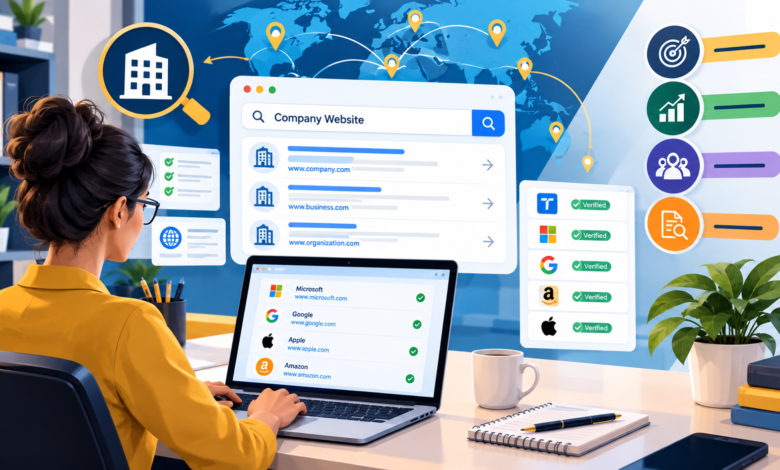
Finding a company’s website may seem like a straightforward task, but it becomes much more complicated when a researcher has hundreds of businesses to investigate. Similar names, subsidiaries, rebranding, regional domains, outdated information, and unofficial websites can all create confusion.
Target Company URL Research provides a structured way to identify the correct website or domain associated with a particular business. It can help sales professionals, marketers, recruiters, SEO specialists, researchers, investors, and data analysts turn company-name lists into usable website information.
However, identifying a domain is only part of the process. The selected website should also be checked carefully to determine whether it really belongs to the intended organization. Automated lookup tools can speed up discovery, but important or unclear matches still benefit from human verification.
Quick Overview of Target Company URL Research
| Item | Details |
|---|---|
| Main purpose | Find and verify a company’s official website |
| Common users | Sales teams, marketers, recruiters, researchers, SEO professionals |
| Starting information | Company name |
| Main result | Website or domain |
| Related research | Products, careers, competitors, contacts and company information |
| Common methods | Search engines, directories, databases and lookup tools |
| Advanced option | Company URL research APIs |
| Essential step | Manual verification |
What Is Target Company URL Research?
Target Company URL Research is the process of locating and confirming the official website belonging to a business selected for research.
The phrase “target company” does not necessarily refer to one particular corporation. In business research, it normally means an organization that has been selected for a specific purpose. That purpose might include sales prospecting, recruitment, SEO analysis, market research, investment research, partnership development, or competitive analysis.
Consider a spreadsheet containing 500 company names but no website addresses. Before researchers can properly investigate those businesses, they need to connect each name with the appropriate domain.
That is where Target Company URL Research becomes useful.
Once a likely domain has been identified, it can become the starting point for examining products, services, leadership, careers, business operations, content, locations, and other public information.
Why Target Company URL Research Matters
A company website can provide valuable first-party information. Depending on the organization, it may contain details about products, services, locations, leadership, careers, partnerships, customers, press releases, and contact channels.
Selecting the wrong website, however, can create problems throughout the entire research process.
Two unrelated companies may have nearly identical names while operating in completely different industries. A researcher who selects the wrong domain could consequently collect incorrect information and add it to a CRM, spreadsheet, report, or marketing database.
Target Company URL Research makes website identification a dedicated stage of the research workflow rather than something researchers simply assume is correct.
Who Can Use Company URL Research?
B2B Sales Professionals
Sales teams often begin with a list of prospective companies. Before contacting those businesses, they need to understand what each organization does.
A verified website can reveal products, services, markets, locations, and business activities. The resulting domain can also be added to CRM records for further enrichment.
Marketing Teams
Marketing departments can use company website research when building lists of potential customers, partners, advertisers, publishers, or competitors.
The official domain provides a useful starting point for studying a company’s digital presence and marketing approach.
Recruiters
Recruiters may need to confirm an employer’s official website and locate its careers section. This becomes especially useful when different organizations have similar names or when a business operates several brands.
SEO Professionals
SEO specialists frequently investigate competitor websites. Once the correct domain has been established, they can study:
- Organic keywords
- Backlinks
- Content strategies
- Ranking pages
- Website structure
- Search visibility
- Competitor content
- Digital PR opportunities
The URL identification stage therefore provides the foundation for later SEO analysis.
Researchers and Analysts
Market researchers and business analysts can use official websites as first-party sources. Instead of depending completely on third-party directories, they can compare information directly with the company’s own published material.
How Target Company URL Research Works
A reliable process can be divided into several stages.
1. Create the Company List
Begin by collecting the organizations that need to be researched. Names may come from a CRM, spreadsheet, business directory, conference list, sales database, or manual research.
For example, a list could contain:
- Shopify
- HubSpot
- Salesforce
- Stripe
- Adobe
The objective is to transform these company names into appropriate domains.
2. Clean the Names
Company names should be standardized before automated searching.
Legal endings such as Inc., Ltd., LLC, PLC, and GmbH can create unnecessary variations. Removing duplicates and standardizing names may improve the matching process. The Target Company URL Research tool described in the supplied material specifically uses this type of cleaning before lookup.
For example:
ABC Technologies LLC
can initially be standardized as:
ABC Technologies
The legal name can still be retained separately for final verification.
3. Find Potential Domains
The next stage is discovering the likely official website.
Small lists can be searched manually through search engines. Larger lists may be processed through directories, lookup services, or APIs.
Automated systems can be particularly useful when hundreds or thousands of company names need to be processed.
4. Review the Match
A returned domain should not automatically be considered correct.
Common business names can produce several possible companies. Lookup services may provide match scores and alternative candidates to help researchers compare results. Such scores generally indicate name similarity rather than legal proof that a particular organization owns the domain.
What Is a Company URL Lookup?
A company URL lookup connects a business name with a likely website address.
The basic process is:
Company Name → Website Domain
This can be performed manually or automatically.
For large datasets, bulk lookup is much more practical than searching every company individually. One current Target Company URL Research tool describes bulk processing of up to 25 names per run and allows results to be exported as CSV data.
What Is a Company Domain Finder?
A company domain finder identifies the web domain associated with a business.
Terms such as company URL finder, company website lookup, company domain finder, and company URL lookup are often used for closely related purposes.
There is, however, a technical difference between a domain and a complete URL.
For example:
example.com is a domain.
A complete URL could be:
For most business research, finding the primary domain is the first objective.
How to Verify the Official Company Website
Verification is one of the most important parts of Target Company URL Research.
Compare the Company Name
Check whether the website identifies itself using the expected company or brand name.
Examine the Industry
Confirm that the business operates in the expected industry. A software company and a construction company can share a similar name but have completely different websites.
Check the Location
Headquarters, offices, service areas, and geographic markets can help separate similarly named organizations.
Read the About Page
The About section may provide information about the company’s history, operations, founders, products, or identity.
Compare Contact Details
Phone numbers, email addresses, physical addresses, and other contact information can provide additional verification signals.
Review Legal Pages
Privacy policies, terms, corporate information, and website footers may reveal the legal entity connected with the domain.
Check Social Profiles
For important prospects, an official LinkedIn profile or other verified social presence can provide another identity signal.
Understanding Match Scores
Some lookup systems provide High, Medium, or Low match levels.
A high score generally indicates strong similarity between the entered company name and the returned business name.
A medium score means the result deserves additional review.
A low score should normally be treated as a research lead rather than confirmed information.
This is important because an algorithm can compare names, but it may not know the precise business relationship a human researcher is trying to establish. Therefore, Target Company URL Research should combine automated matching with manual review when accuracy matters.
Common Challenges in Company URL Research
Similar Names
Several unrelated businesses can use identical or nearly identical names.
Rebranding
A company may change its name or domain, leaving older information in databases and search indexes.
Parent Companies and Subsidiaries
A subsidiary may maintain its own website while the parent organization uses another domain.
Regional Websites
International businesses can operate country-specific domains alongside a global website.
Brand and Legal Entity Differences
A consumer-facing brand may not have the same name as the legal company that owns it.
These situations make verification essential.
Target Company URL Research for B2B Prospecting
B2B prospecting is an important use of Target Company URL Research.
A typical workflow can be:
Build prospect list → Find domains → Verify websites → Research companies → Identify decision-makers → Qualify prospects → Begin outreach
Once the correct website has been established, sales professionals can examine product pages, services, target markets, and other information before approaching the organization.
This provides a stronger research foundation than sending identical messages to every company.
Target Company URL Research for SEO
SEO professionals can also benefit from accurate domain identification.
After confirming the correct website, researchers can investigate:
- Competitor keywords
- Backlinks
- Content gaps
- Ranking pages
- Internal linking
- Search intent
- Website categories
- Organic visibility
- Digital PR opportunities
It is important to separate the two tasks. Target Company URL Research identifies the website to investigate, while SEO platforms and analysis methods determine how that website performs in search.
Company URL Research APIs
Organizations working with large datasets may use APIs to automate website discovery.
A basic workflow is:
Company Name → API Request → Matching Company → Domain → Confidence Information
API-based research can support CRMs, spreadsheets, lead-generation systems, internal databases, and data-cleaning workflows.
The supplied TargetCompanyURLResearch material describes API-based lookup as an advanced method and notes that structured results can include information such as domains, confidence data, careers URLs, industry information, and regional website options.
Automation saves time, but important results should still be reviewed.
Company URL Research and Careers Pages
Careers research is another useful application.
Common paths include:
/careers/jobs/join-us/work-with-us
Not every company uses these exact structures, so a generated careers URL is not proof that a page exists.
The described careers finder builds common URL patterns after identifying a company’s domain. It does not provide live job listings or confirm that an organization is currently hiring. Some generated links may also return a 404 error.
Manual Research vs. Automated Lookup
| Method | Best Use | Main Benefit |
|---|---|---|
| Manual search | Small lists | Flexible |
| Business directory | Specific industries | Organized information |
| URL lookup tool | Medium lists | Faster processing |
| API | Large datasets | Automation |
| Manual verification | Important accounts | Greater confidence |
In practice, combining automation with human review can be useful. Automated tools identify possible domains, while researchers verify ambiguous or high-value results.
Best Practices for Target Company URL Research
Several habits can improve results:
Use Clean Names
Remove unnecessary variations and duplicate records before lookup.
Investigate Ambiguous Names
Common names should receive additional attention.
Verify Important Accounts
Open the website and compare identity information before using it in important research, outreach, or CRM records.
Save the Verified Domain
Keep the final domain in your spreadsheet or CRM.
Record Verification Status
Useful columns can include:
Company Name | Domain | Match Score | Country | Industry | Verification Status | Notes
Recheck Older Data
Websites, brands, and company structures can change, so old datasets should be reviewed periodically.
Never Assume Automation Is Perfect
Automated matching improves efficiency but cannot eliminate ambiguity.
Is Target Company URL Research the Same as Target Corporation Research?
No.
Target Company URL Research uses “target company” as a general B2B term for a business selected for research, prospecting, recruitment, or analysis.
It should not automatically be interpreted as research about Target Corporation, the American retailer.
Understanding this distinction prevents confusion when searching for information.
The Future of Company Website Research
As company databases become larger and digital business information continues to expand, automated website research can remain valuable.
AI-powered and data-enrichment systems may combine company names with geography, industry, social profiles, corporate records, and other signals to improve matching.
Nevertheless, the fundamental objective remains the same: finding the correct official website for the exact company being researched.
The value of Target Company URL Research therefore comes from combining speed with accuracy. A tool may identify a likely domain quickly, but verification determines whether that domain is actually appropriate.
Frequently Asked Questions
What is Target Company URL Research?
Target Company URL Research is the process of finding and verifying the official website or domain associated with a selected business.
What is a company URL finder?
A company URL finder connects a company name with a possible website or domain.
Why is company domain research important?
It helps prevent researchers from analyzing the wrong organization and provides a starting point for sales, recruitment, SEO, and market research.
Can company URL lookup be automated?
Yes. Lookup tools, databases, spreadsheets, and APIs can automate much of the process, especially when working with large company lists.
Are company URL lookup results always accurate?
No. Similar names, subsidiaries, regional domains, rebranding, and incomplete databases can result in incorrect matches. Important results should be verified manually.
What is the difference between a domain and a URL?
A domain is the main website address, such as example.com. A URL can identify a complete web address, including a specific page.
Who uses Target Company URL Research?
Sales teams, marketers, recruiters, SEO professionals, researchers, investors, consultants, and data analysts can all use company website research.
Conclusion
Target Company URL Research is an important foundation for modern business research. Correctly identifying a company’s website makes it easier to investigate products, services, careers, competitors, SEO activity, leadership, and business opportunities.
Manual searches can work for a few companies, while lookup tools and APIs can make larger datasets easier to process. The most dependable approach combines automated discovery with human verification.
Ultimately, Target Company URL Research is not only about finding websites quickly. It is about making sure the website belongs to the exact business being investigated. That accuracy gives sales professionals, marketers, recruiters, SEO specialists, and researchers a stronger foundation for everything they do afterward.
Visit ukstory for more posts